Introduction
Neurons communicate by generating action potentials (potential difference through their cell membranes), which propagate along the axon towards the synapses of other cells. There exist various models, based on systems of ordinary differential equations, describing the dynamics of action-potential generation: The Hodgkin-Huxley equations, the FitzHugh-Nagumo equations, the Morris-Lecar equations, etc.
An important property of models for action-potential generation is that they are able to reproduce the spiking behaviour of neurons. A spike corresponds to a quick increase of the action potential, followed by a slower decay, before the neuron returns to rest. An ordinary differential equation can reproduce this behaviour if it shows excitability. This is the case, for instance, if it admits an asymptotically stable equilibrium point, such that some orbits starting near the equilibrium point make a large excursion in phase space before returning to it. One can then consider that a spike is induced by a small deterministic perturbation, moving the state of the system away from the equilibrium point.
We are interested in describing the generation of spikes by stochastic, as opposed to deterministic, perturbations. In particular, we would like to describe the distribution of interspike intervals, in function of the excitability properties of the model and the noise intensity. By comparison with experimental date, this should allow to improve the models for action-potential generation.
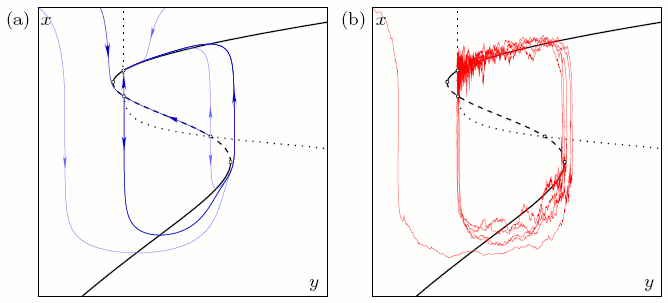
(a) Some orbits of the deterministic Morris-Lecar model, in a parameter range where it shows excitability: Both unstable manifolds of the saddle point converge to the same stable equilibrium point, but they have very different lenghts. The dotted curve is the nullcline on which the derivative of the slow variable y vanishes. The full and broken curves are the points where the derivative of the fast variable x vanishes. (b) When noise is added to the fast variable, orbits spend some time near the stable equilibrium point, before crossing the saddle, and making a large excursion following the the long unstable manifold, before returning to the stable point.
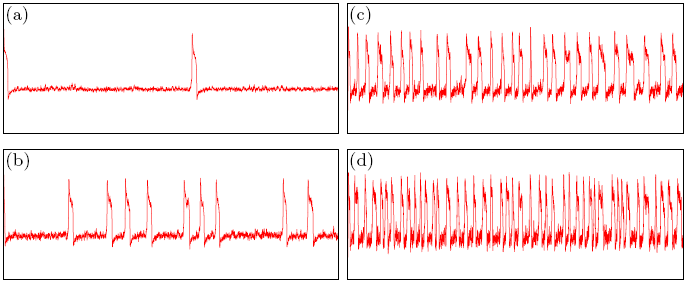
Plots of -xt as a function of time t, for increasing noise intensities, showing the transition from rare spikes following a Poisson process to frequent, more regularly spaced spikes.