Stochastic conduction-based models for neuronal spike generation
An overview is given in
this book chapter and in
this short proceedings.
- Interspike interval statistics for the FitzHugh-Nagumo equations
In his thesis, Damien Landon has considered the stochastic FitzHugh-Nagumo equations
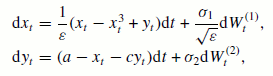
describing the evolution of action potentials in neuron axons. The conjectured bifurcation
diagram has the following form:
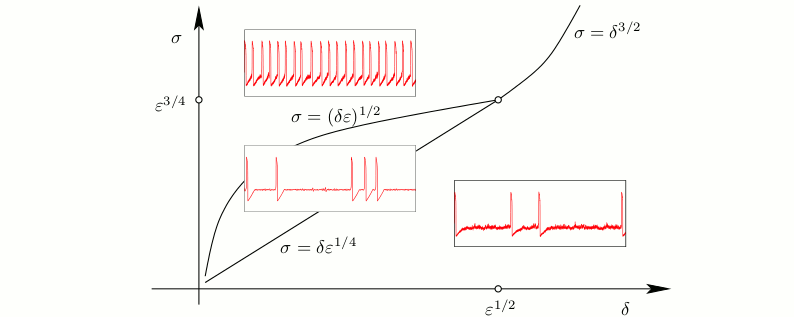
The bifurcation parameter δ is related to a and c and measures the distance to a singular Hopf bifurcation, ε is the time scale separation, and σ measures the noise intensity. The three main regimes show rare isolated spikes,
clusters of spikes and repeated spikes.
Results in this article describe the transition
from weak to strong noise by characterising the random variable N giving the number
of small oscillations between two consecutive spikes. N has an asymptotically geometric
distribution, with a parameter that can be expressed as a function of δ, σ and ε, compatible with the conjectured bifurcation diagram.
- Mixed-mode oscillations in dimension 3
With Barbara
Gentz and Christian Kuehn,
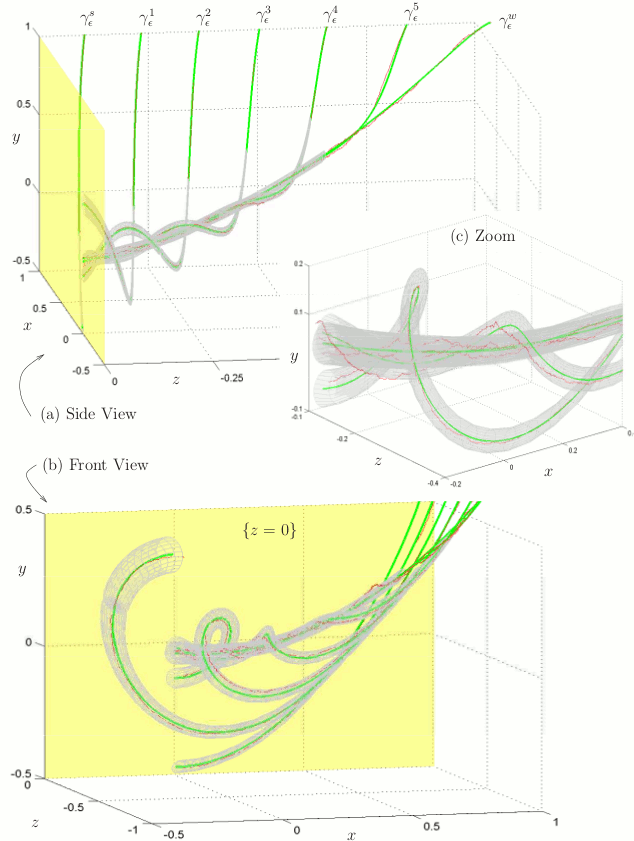
I have studied the stochastic differential equation
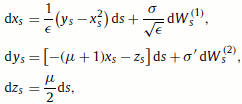
describing the normal form near a folded-node singularity, for a system with one fast and two
slow variables. In the deterministic case, this system is known to have a number of
canard solutions, staying near the critical manifold both on the stable and unstable side.
In this article, we quantify two effects of noise
on the system. First, we determine covariance tubes around the deterministic canards, in
which the sample paths stay with high probability. This yields critical noise intensities,
above which small oscillations are masked by fluctuations. Second, we show that unless the noise
in exponentially small, sample paths are likely to depart from canards shortly after reaching
the unstable side of the critical manifold.
In this article, we generalise the results to a larger
class of systems with an S-shaped critical manifold and a folded-node singularity, and obtain
estimates on the kernel of the systems' Poincaré map. These results allow to quantify
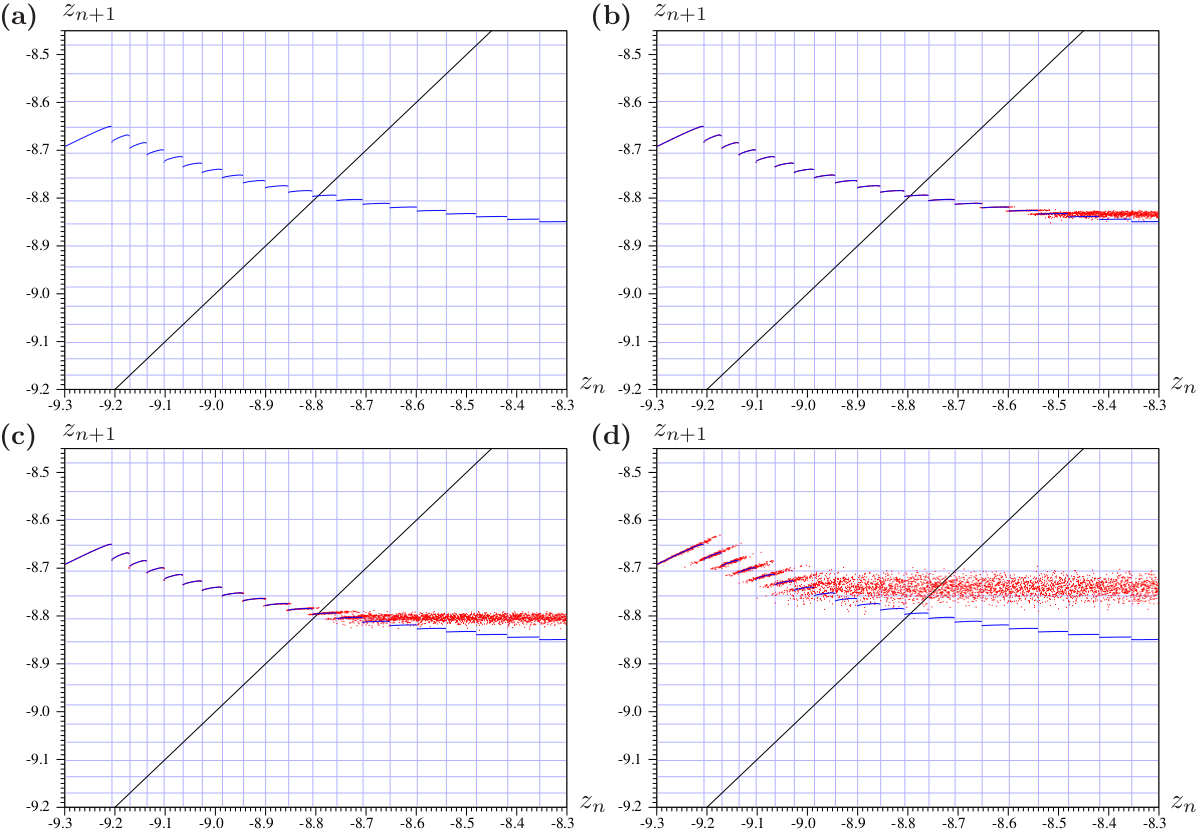
the possible mixed-mode oscillation patterns of the system. The following figure shows the
Poincaré map of the Koper model for increasing noise intensities. Sufficiently strong
noise may result in increasing the number of small-amplitude oscillations between sucessive
large-amplitude oscillations.