Effect of additive noise on bifurcation delay
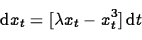
When determining a bifurcation diagram experimentally, one can be tempted to sweep the bifurcation parameter slowly through its entire range in order to save time. So-called dynamic bifurcations can, however, display unexpected phenomena such as bifurcation delay, which may prevent the determination of stable equilibrium branches. Consider for instance a pitchfork bifurcation of the form
The origin x = 0 is stable for λ < 0 and unstable for λ > 0. In addition, for positive λ, there are two stable equilibrium branches at λ1/2 and -λ1/2. If the parameter is slowly swept, for instance λ = εt, solutions of the resulting non-autonomous equation are known to track the unstable branch for an appreciable time, even in the limit of vanishing ε (see the blue curve in the picture below).
The influence of additive noise can be described by a stochastic differential equation of the form

The figure below shows paths for different noise intensities, but the same realization of Brownian motion Wt.
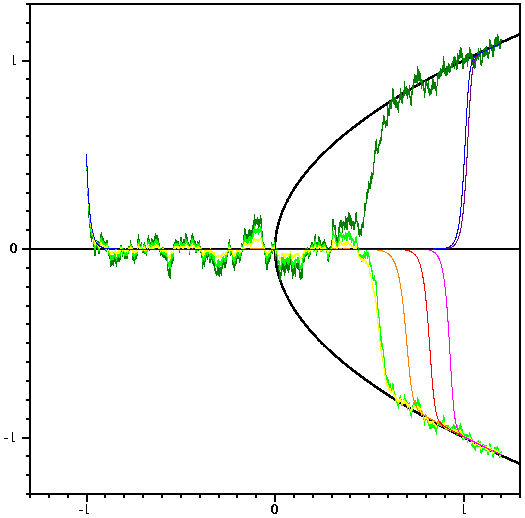
Paths of the above stochastic differential equation for ε = 0.02, same realization of noise, and different noise intensities: σ = 0, σ = 2 10-10, σ = 2 10-8, σ = 2 10-6, σ = 2 10-4, σ = 0.02, σ = 0.04, and σ = 0.06. The logarithmic dependence of bifurcation delay on noise intensity is clearly apparent.
In this paper, we prove that with probability exponentially close to 1, the paths behave in the following way:
These results show in particular that in order to obtain a trustworthy image of the bifurcation diagram, for given noise intensity σ, the rate ε of parameter sweep should be small compared to 1/|log σ| in order to prevent bifurcation delay, but large compared to σ2 in order to obtain a sharp image of equilibrium branches.
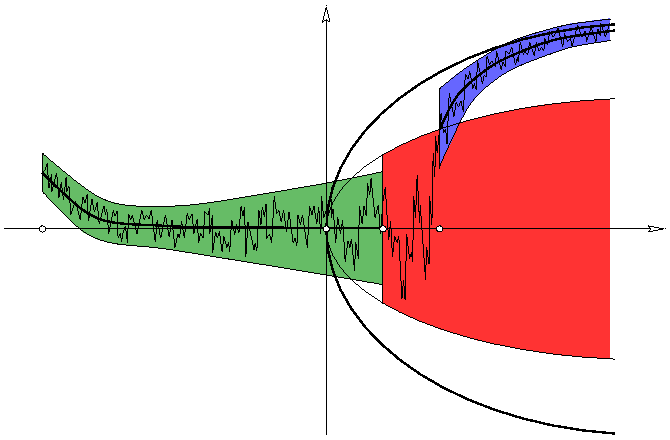
A typical path remains inside the green region until slow time ε1/2 after the bifurcation point. The green region is centered at a solution of the deterministic equation (heavy black curve), and has a width proportional to the standard deviation of the stochastic differential equation linearized around this solution. The path is likely to leave the red region before a slow time of order (ε|log σ|)1/2 after the bifurcation, after which it is likely to remain in the blue region, again centered at a deterministic solution.