 with F. Bärtl, N. Stegani, F. Caglieris, I. Shipulin, Y. Li,
Q. Hu, Y. Zheng, C.-M. Yim, S. Luther, J. Wosnitza, R. Sarkar,
H.-H. Klauss, A. Samoilenka, A. Talkachov, E. Babaev, H. Kühne, and V. Grinenko
with F. Bärtl, N. Stegani, F. Caglieris, I. Shipulin, Y. Li,
Q. Hu, Y. Zheng, C.-M. Yim, S. Luther, J. Wosnitza, R. Sarkar,
H.-H. Klauss, A. Samoilenka, A. Talkachov, E. Babaev, H. Kühne, and V. Grinenko
Zero-field muon-spin-rotation ($\mu$SR) experiments and the observation of a spontaneous Nernst
effect indicate broken time-reversal symmetry (BTRS) at $\TcZtwo$, slightly above the superconducting
transition temperature $\Tc{}$ in $\bkfa$ with $x \approx 0.8$. This was interpreted as evidence of a
distinct state of matter where BTRS above $\Tc{}$ arises from noncondensed Cooper pairs,
which maintain long-range interband correlations. However, an inhomogeneous superconducting state
competing with magnetism as the origin of the observed behavior cannot be completely ruled out to date.
Here, we present detailed $^{75}$As nuclear magnetic resonance (NMR) measurements of $\bkfa$ with $x = 0.766$,
yielding $\TcZtwo > \Tc{}$. The NMR data demonstrate that the superconductivity is homogeneous throughout
the entire sample volume despite the occurrence of nanoclustering of Ba/K atoms.
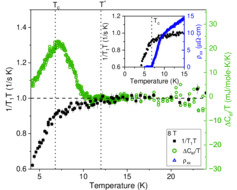
We observe a suppression of the spin-lattice relaxation rate $1/T_1T$ below the characteristic temperature $T^*$,
well above $\Tc{}$. The specific heat yields somewhat lower values of $T^*$, consistent with the microscopic
theory of electron quadrupling. The observed monotonous suppression of $T^*$ and $\TcZtwo$ in applied magnetic field,
the overall temperature dependence of $1/T_1T$, the NMR spectral characteristics, and the $\mu$SR` Knight shift
rule out spin magnetism and the proximity to a magnetic instability.
We conclude that our data indicate the appearance of pairing fluctuations below $T^*$ and that the breaking
of time-reversal symmetry represents an unconventional state which is unrelated to spin magnetism.
 with A. Niemi
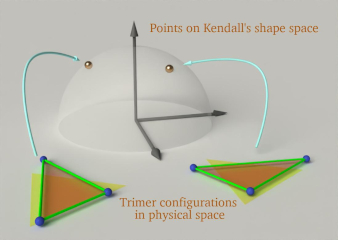
Motivated by programmable tweezer arrays, we develop an exactly solvable shape-space theory
for near-equilateral atomic trimers. The Higgs oscillator on Kendall's shape sphere gives a nonresonant
spectral lattice whose fixed-angular-momentum relative-stationary minimizers are supported on
two adjacent admissible sites. These symmetry-selected doublets are separated from higher
relative-stationary branches by a finite branch gap. With phase-coherent shape-mode driving
and Rydberg-mediated conditional phases, they furnish a candidate route to geometric qubits
and entangling operations.
 with Y. Zheng, Q. Hu, X. Yu, H. Ji, I. Timoshuk, H. Xu, Y.Li,
Y. Gao, X. Lu, V. Grinenko, E. Babaev, N. F. Q. Yuan, R. Wu
B. Lv, C.-M. Yim, and H. Ding
with Y. Zheng, Q. Hu, X. Yu, H. Ji, I. Timoshuk, H. Xu, Y.Li,
Y. Gao, X. Lu, V. Grinenko, E. Babaev, N. F. Q. Yuan, R. Wu
B. Lv, C.-M. Yim, and H. Ding
Magnetic fields can penetrate a superconductor in the form of quantum vortices,
which consist of a core singularity with circulating currents. London’s quantization implies
that there is one core singularity per quantum of magnetic flux in single-component superconductors.
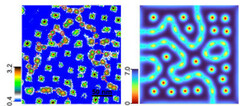
Here, we report signatures of quantum vortex core fractionalization on the potassium-terminated surface
of a multiband superconductor KFe$_2$As$_2$. The observed splitting of single integer-flux vortices
into several fractional vortices results in a disparity between the numbers of flux quanta and vortex cores.
These fractional vortices often arrange in chains, which calculations show are characterized by a $\mathbb{C}P^2$
skyrmionic topological invariant; this constitutes a different type of topological defect: the chiral skyrmion.
The disparate natures of integer and fractional vortices comprising skyrmions lead to distinct spectroscopic signatures.
 with Q. Z. Zhou, B. R. Chen, B. K. Xiang, I. Timoshuk, Y. Li, K. Kihou,
K. Y. Liang, Q. S. He, Z. J. Li, P. H. Zhang, K. Z. Yao, H. X. Yao,
E. Babaev, V. Grinenko, and Y. H. Wang
with Q. Z. Zhou, B. R. Chen, B. K. Xiang, I. Timoshuk, Y. Li, K. Kihou,
K. Y. Liang, Q. S. He, Z. J. Li, P. H. Zhang, K. Z. Yao, H. X. Yao,
E. Babaev, V. Grinenko, and Y. H. Wang
Since their theoretical discovery more than a half-century ago, vortices observed
in bulk superconductors have carried a quantized value of magnetic flux
determined only by fundamental constants. A recent experiment reported
'unquantized' quantum vortices carrying the same fraction of flux quantum in
Ba$_{0.23}$K$_{0.77}$Fe$_2$As$_2$ in a small temperature range below its superconducting
critical temperature ($T_c$). Here, we use scanning superconducting quantum interference
device (sSQUID) microscopy with improved sensitivity to investigate the genesis
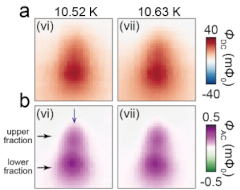
of fractional vortices in Ba$_{0.23}$K$_{0.77}$Fe$_2$As$_2$. We report the direct
observation of a single-flux quantum vortex splitting into two different fractions
with increasing temperature. The flux of the two fractions has opposite dependence
on temperature, while the total flux sums up to one flux quantum despite their
spatial separation. Overall, our study shows the existence of different fractional
vortices and their stability in temperature ranging from 0.1 to 0.99 $\Tc{}$. Besides
the implications of this observation for the fundamental question of quantum
vorticity, the discovery of these objects paves the way for the new platform for
anyon quasiparticles and applications for fractional fluxonics.
Preprint (2024)
Link
 with A. Korneev, A. Samoilenka, A. Molochkov,
E. Babaev, and M. Chernodub
with A. Korneev, A. Samoilenka, A. Molochkov,
E. Babaev, and M. Chernodub
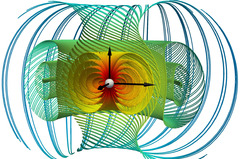
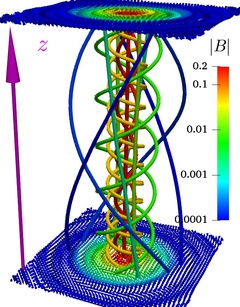
We demonstrate that superconductors with broken inversion symmetry support a family
of stable, spatially localized configurations of the self-knotted magnetic field.
These solutions, that we term ``toroflux,'' are the superconducting
counterparts of the Chandrasekhar-Kendall states (spheromaks) that appear in highly
conducting, force-free astrophysical and nuclear-fusion plasmas.
The superconducting torofluxes are solutions of superconducting models, in the presence
of a parity-breaking Lifshitz invariant associated with the $O$ point-group symmetry.
These solutions are characterized by a non-vanishing helicity of the magnetic field,
and also by a toroidal dipole moment of the magnetic field.
We demonstrate that a magnetic dipole or a ferromagnetic inclusion in the bulk
of a noncentrosymmetric superconductor sources finite-energy toroflux solutions.
Published in
Phys. Rev. B 108, 014504 (2023)
 with E. Babaev
Recent experiments [Grinenko et al.
Nature Physics 17, 1254–1259 (2021)]
reported the observation of a condensate of four-fermion composites. This is a resistive
state that spontaneously breaks the time-reversal symmetry, leading to unconventional
magnetic properties, detected in muon spin rotation experiments and by the appearance of
a spontaneous Nernst effect.
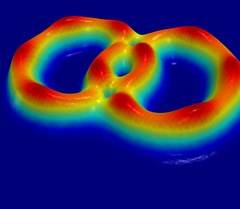
In this work, we derive an effective model for the four-fermion order parameter that
describes the observed spontaneous magnetic fields in this state. We show that this model,
which is alike to the Faddeev-Skyrme model can host skyrmions: magnetic-flux-carrying
topological excitations.
Published in
Phys. Rev. Lett. 129, 087602 (2022)
 with V. Grinenko, D. Weston, F. Caglieris, C. Wuttke, C. Hess,
T. Gottschall, I. Maccari, D. Gorbunov, S. Zherlitsyn, J. Wosnitza,
A. Rydh, K. Kihou, C.-H. Lee, R. Sarkar, S. Dengre, A. Charnukha,
R. Hühne, K. Nielsch, B. Büchner, H.-H. Klauss,
and E. Babaev
with V. Grinenko, D. Weston, F. Caglieris, C. Wuttke, C. Hess,
T. Gottschall, I. Maccari, D. Gorbunov, S. Zherlitsyn, J. Wosnitza,
A. Rydh, K. Kihou, C.-H. Lee, R. Sarkar, S. Dengre, A. Charnukha,
R. Hühne, K. Nielsch, B. Büchner, H.-H. Klauss,
and E. Babaev
(phys.org) -- “ Reporting today in Nature Physics,
Professor Egor Babaev and collaborators presented evidence of fermion
quadrupling in a series of experimental measurements on the iron-based material,
Ba$_{1-x}$K$_x$Fe$_2$As$_2$. The results follow nearly 20 years after Babaev
first predicted this kind of phenomenon, and eight years after he published a
paper predicting that it could occur in the material. ”
Read more on
phys.org,
see also
Nature metrics.
Article relegated in several popular science media : phys.org , sciencesetavenir.fr , fr-24.com , techexplorist.com , jaituss.com , newsbeezer.com , newsfounded.com , eurekalert.org , finance.sina.com.cn , scitechdaily.com , shouzy.com ,
 with V. Grinenko, D. Weston, F. Caglieris, C. Wuttke, C. Hess,
T. Gottschall, I. Maccari, D. Gorbunov, S. Zherlitsyn, J. Wosnitza,
A. Rydh, K. Kihou, C.-H. Lee, R. Sarkar, S. Dengre, A. Charnukha,
R. Hühne, K. Nielsch, B. Büchner, H.-H. Klauss,
and E. Babaev
with V. Grinenko, D. Weston, F. Caglieris, C. Wuttke, C. Hess,
T. Gottschall, I. Maccari, D. Gorbunov, S. Zherlitsyn, J. Wosnitza,
A. Rydh, K. Kihou, C.-H. Lee, R. Sarkar, S. Dengre, A. Charnukha,
R. Hühne, K. Nielsch, B. Büchner, H.-H. Klauss,
and E. Babaev
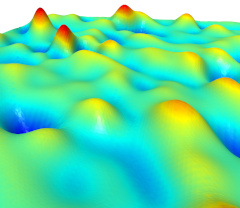
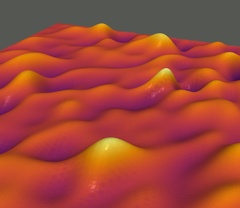
The most well-known example of an ordered quantum state--superconductivity--is
caused by the formation and condensation of pairs of electrons. Fundamentally,
what distinguishes a superconducting state from a normal state is a spontaneously
broken symmetry corresponding to the long-range coherence of pairs of electrons,
leading to zero resistivity and diamagnetism. Here we report a set of experimental
observations in hole-doped Ba$_{1-x}$K$_x$Fe$_2$As$_2$. Our specific-heat
measurements indicate the formation of fermionic bound states when the temperature
is lowered from the normal state. However, when the doping level is $x \approx 0.8$,
instead of the characteristic onset of diamagnetic screening and zero resistance
expected below the superconducting phase transition, we observe the opposite effect:
the generation of self-induced magnetic fields in the resistive state, measured by
spontaneous Nernst effect and muon spin rotation experiments. This combined evidence
indicates the existence of a bosonic metal state in which Cooper pairs of electrons
lack coherence, but the system spontaneously breaks time-reversal symmetry.
The observations are consistent with the theory of a state characterized by fermionic
quadrupling correlations, in which long-range order exists not between Cooper pairs
but only between pairs of pairs.
Published in
Nature Physics 17, 1254–1259 (2021)
 with A. J. Niemi
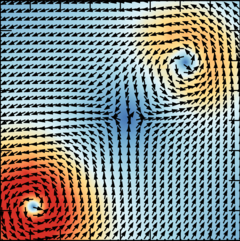
A dilute gas of Bose-Einstein condensed atoms in a non-rotated and axially symmetric
harmonic trap is modelled by the time dependent Gross-Pitaevskii equation.
When the angular momentum carried by the condensate does not vanish, the minimum
energy state describes vortices (or antivortices) that propagate around the trap center.
The number of (anti)vortices increases with the angular momentum, and they repel each other
to form Abrikosov lattices.
Besides vortices and antivortices there are also stagnation points where the superflow vanishes;
to our knowledge the stagnation points have not been analyzed previously, in the context of
the Gross-Pitaevskii equation. The Poincar\'e index formula states that the difference
in the number of vortices and stagnation points can never change.
When the number of stagnation points is small, they tend to aggregate into degenerate
propagating structures.
But when the number becomes sufficiently large, the stagnation points tend to pair up
with the vortex cores, to propagate around the trap center in regular lattice arrangements.
There is an analogy with the geometry of the Kosterlitz-Thouless transition, with
the angular momentum of the condensate as the external control parameter instead
of the temperature.
Published in
J. High Energ. Phys. 2022, 154 (2022)
 with J. Dai and A. J. Niemi
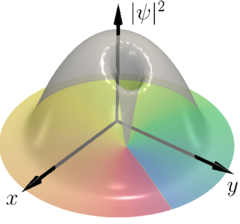
Vortices in a Bose-Einstein condensate are modelled as spontaneously symmetry breaking
minimum energy solutions of the time dependent Gross-Pitaevskii equation, using the method
of constrained optimization. In a non-rotating axially symmetric trap, the core of a single
vortex precesses around the trap center and, at the same time, the phase of its wave function
shifts at a constant rate. The precession velocity, the speed of phase shift, and the distance
between the vortex core and the trap center, depend continuously on the value of the conserved
angular momentum that is carried by the entire condensate. In the case of a symmetric pair of
identical vortices, the precession engages an emergent gauge field in their relative coordinate,
with a flux that is equal to the ratio between the precession and shift velocities.
Published in
J. High Energ. Phys. 2021, 157 (2021)
 with F. N. Krohg, E. Babaev, H. H. Haugen, and A. Sudbø
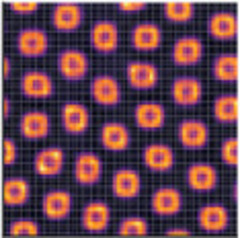
We use large-scale Monte-Carlo simulations to study thermal fluctuations in chiral $p$-wave
superconductors in an applied magnetic field in three dimensions. We consider the thermal
stability of previously predicted unusual double-quanta flux-line lattice ground states in
such superconductors. In previous works it was shown that, neglecting thermal fluctuations,
a chiral $p$-wave superconductor forms an hexagonal lattice of doubly-quantized vortices,
except extremely close to the vicinity of $H_{c2}$ where double-quanta vortices split apart.
We find dissociation of double-quanta vortices driven by thermal fluctuations. However,
our calculations also show that the previous predictions of hexagonal doubly-quantized
vortices, where thermal fluctuations were ignored, are very robust in the considered model.
Published in
Phys. Rev. B 103, 214517 (2021)
 with M. N. Chernodub and D. E. Kharzeev
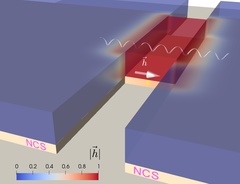
Superconducting materials with noncentrosymmetric lattices lacking space
inversion symmetry exhibit a variety of interesting parity-breaking phenomena,
including the magneto-electric effect, spin-polarized currents, helical states,
and the unusual Josephson effect. We demonstrate, within a Ginzburg-Landau
framework describing noncentrosymmetric superconductors with $O$ point group
symmetry, that vortices can exhibit an inversion of the magnetic field at a
certain distance from the vortex core. In stark contrast to conventional
superconducting vortices, the magnetic-field reversal in the parity-broken
superconductor leads to non-monotonic intervortex forces, and, as a consequence,
to the exotic properties of the vortex matter such as the formation of vortex
bound states, vortex clusters, and the appearance of metastable vortex/anti-vortex
bound states.
Published in
Phys. Rev. B 102, 184516 (2020)
 with M. N. Chernodub and D. E. Kharzeev
The lack of space inversion symmetry endows non-centrosymmetric superconducting
materials with various interesting parity-breaking phenomena, including the anomalous
Josephson effect. Our paper considers a Josephson junction of two non-centrosymmetric
superconductors connected by a uniaxial ferromagnet. We show that this
"Chiral Magnetic Josephson junction" (CMJ junction) exhibits a direct analog of the
Chiral Magnetic Effect, which has already been observed in Weyl and Dirac and semimetals.
We suggest that the CMJ can serve as an element of a qubit with a Hamiltonian tunable
by the ferromagnet's magnetization. The CMJ junction avoids using an offset magnetic
flux in inductively shunted qubits, thus enabling a simpler and more robust architecture.
Furthermore, when the uniaxial ferromagnet's easy axis is directed across the junction,
the resulting "chiral magnetic qubit" provides robust protection from the noise caused
by magnetization fluctuations.
Published in
Universe 8, 12:657 (2022)
 with Filipp Rybakov and Egor Babaev
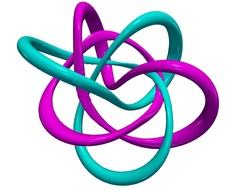
At large scales, magnetostatics of superconductors is described by
a massive vector field theory: the London model. The magnetic field
cannot penetrate into the bulk unless quantum vortices are formed.
These are topological excitations characterized by an invariant:
the phase winding. The London model dictates that loops of such vortices
are not stable because the kinetic energy of superflow and the magnetic
energy are smaller,the smaller vortex loops are. We demonstrate that
in two-component superconductors, under certain conditions, such as
the proximity to pair-density-wave instabilities, the hydromagnetostatics
of the superconducting state and topological excitation changes dramatically:
the excitations acquire the form of stable vortex loops and knots characterized
by the different topological invariant: the Hopf index and hence termed hopfions.
This demonstrates that magnetic properties in a superconducting state can be
dramatically different from those of a London’s massive vector field theory.
Published in
Phys. Rev. B 100, 094515 (2019)
 with J. D.S. Bommer, H. Zhang, Ö. Gül, B. Nijholt, M. Wimmer,
F. N. Rybakov, D. Rodic, E. Babaev, M. Troyer, D. Car, S. R. Plissard,
E. P.A.M. Bakkers, K. Watanabe, T. Taniguchi, and L. P. Kouwenhoven
with J. D.S. Bommer, H. Zhang, Ö. Gül, B. Nijholt, M. Wimmer,
F. N. Rybakov, D. Rodic, E. Babaev, M. Troyer, D. Car, S. R. Plissard,
E. P.A.M. Bakkers, K. Watanabe, T. Taniguchi, and L. P. Kouwenhoven
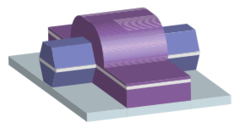
Spin-orbit interaction (SOI) plays a key role in creating Majorana zero
modes in semiconductor nanowires proximity coupled to a superconductor.
We track the evolution of the induced superconducting gap in InSb nanowires
coupled to a NbTiN superconductor in a large range of magnetic field
strengths and orientations. Based on realistic simulations of our devices,
we reveal SOI with a strength of 0.15—0.35 eV Å. Our approach identifies
the direction of the spin-orbit field, which is strongly affected by the
superconductor geometry and electrostatic gates.
Published in
Phys. Rev. Lett. 122, 187702 (2019) ,
see also arXiv:1807.01940 [cond-mat.mes-hall]
 with Alberto Corticelli, Mihail Silaev and Egor Babaev
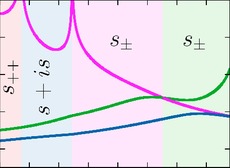
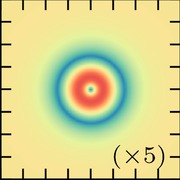
Disorder in two-band superconductors with repulsive interband interaction
induces a frustrated competition between the phase-locking preferences of
the various potential and kinetic terms. This frustrated interaction can
result in the formation of an $s+is$ superconducting state, that breaks the
time-reversal symmetry.
In this paper we study the normal modes and their associated coherence lengths
in such materials. We especially focus on the consequences of the soft modes
stemming from the frustration and time-reversal-symmetry breakdown. We find that
two-bands superconductors with such impurity-induced frustrated interactions
display a rich spectrum of physical properties that are absent in their clean
counterparts.
It features a mixing of Leggett's and Anderson-Higgs modes, and a soft mode
with diverging coherence length at the impurity-induced second order phase
transition from $s_{\pm}/s_{++}$ states to the $s+is$ state. Such a soft
mode generically results in long-range attractive intervortex forces that
can trigger the formation of vortex clusters. We find that, if such
clusters are formed, their size and internal flux density have a
characteristic temperature dependence that could be probed in
muon-spin-rotation experiments. We also comment on the appearance of
spontaneous magnetic fields due to spatially varying impurities.
Published in
Phys. Rev. B 98, 014520 (2018)
 with Alberto Corticelli, Mihail Silaev and Egor Babaev
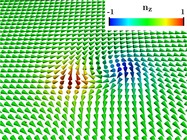
In multiband systems, such as iron-based superconductors, the superconducting
states with locking and anti-locking of the interband phase differences,
are usually considered as mutually exclusive. For example, a dirty two-band
system with interband impurity scattering undergoes a sharp crossover between
the $s_{\pm}$ state (which favors phase anti locking) and the $s_{++}$ state
(which favors phase locking).
We discuss here that the situation can be much more complex in the presence
of an external field or superconducting currents. In an external applied
magnetic field, dirty two-band superconductors do not feature a sharp
$s_{\pm}\to s_{++}$ crossover but rather a washed-out crossover to a finite
region in the parameter space where both $s_{\pm}$ and $s_{++}$ states can
coexist for example as a lattice or a microemulsion of inclusions of different
states.
The current-carrying regions such as the regions near vortex cores can exhibit
an $s_\pm$ state while it is the $s_{++}$ state that is favored in the bulk.
This coexistence of both states can even be realized in the Meissner state
at the domain's boundaries featuring Meissner currents. We demonstrate that
there is a magnetic-field-driven crossover between the pure $s_{\pm}$ and
the $s_{++}$ states.
Published in
Phys. Rev. B 97, 054520 (2018)
 with A. A. Zyuzin and Egor Babaev
We study topological excitations in two-component nematic superconductors,
with a particular focus on Cu$_x$Bi$_2$Se$_3$ as a candidate material.
We find that the lowest-energy topological excitations are coreless vortices:
a bound state of two spatially separated half-quantum vortices. These objects
are nematic Skyrmions, since they are characterized by an additional
topological charge.
The inter-Skyrmion forces are dipolar in this model, i.e. attractive for
certain relative orientations of the Skyrmions, hence forming multi-Skyrmion
bound states.
Published in
Phys. Rev. Lett. 96, 140503 (2017)
 with Mihail Silaev and Egor Babaev
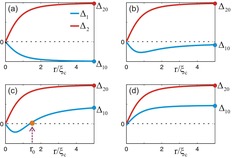
We report a nontrivial transition in the core structure of vortices in
two-band superconductors as a function of interband impurity scattering.
We demonstrate that, in addition to singular zeros of the order parameter,
the vortices there can acquire a circular nodal line around the singular
point in one of the superconducting components. It results in the formation
of the peculiar ``moat"-like profile in one of the superconducting gaps.
The moat-core vortices occur generically in the vicinity of the
impurity-induced crossover between $s_{\pm}$ and $s_{++}$ states.
Published in
Phys. Rev. B 96, 140503(R) (2017)
 with Mihail Silaev and Egor Babaev
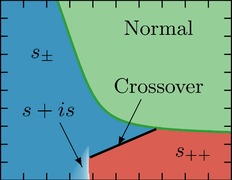
We investigate the phase diagram of dirty two-band superconductors.
This paper primarily focuses on the properties and observability of the
time-reversal symmetry-breaking $s+is$ superconducting states, which
can be generated in two-band superconductors by interband impurity
scattering. We show that such states can appear in two distinct ways.
First, according to a previously discussed scenario, the $s+is$ state can
form as an intermediate phase at the impurity-driven crossover between
$s_{\pm}$ and $s_{++}$ states. We show that there is a second scenario
where domains of the $s+is$ state exists in the form of an isolated
dome inside the $s_{\pm}$ domain, completely detached from the transition
between $s_{\pm}$ and $s_{++}$ states. We demonstrate that in both cases
the $s+is$ state, generated by impurity scattering exists in an extremely
small interval of impurity concentrations. Although this likely precludes
direct experimental observation of the $s+is$ state formation due to this
mechanism, this physics leads to the appearance of a region inside both
the $s_{\pm}$ and $s_{++}$ domains with unusual properties due to
softening of normal modes.
Published in
Phys. Rev. B 95, 024517 (2017)
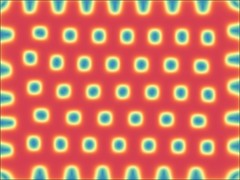 with Egor Babaev, Troels Arnfred Bojesen and Asle Sudbø
We investigate the magnetization processes of a standard Ginzburg-Landau model for
chiral $p$-wave superconducting states in an applied magnetic field. We find that
the phase diagram is dominated by triangular lattices of doubly quantized vortices.
Only in close vicinity to the upper critical field, the lattice starts to dissociate
into a structure of single-quanta vortices.
The degeneracy between states with opposite chirality is broken in a nonzero field.
If the magnetization starts with an energetically unfavorable chirality, the process
of chirality-inversion induced by the external magnetic field results in the formation
of a sequence of metastable states with characteristic magnetic signatures that can
be probed by standard experimental techniques.
Published in
Phys. Rev. B 94, 104509 (2016)
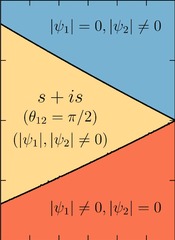 with Mihail Silaev and Egor Babaev
Starting with the generic Ginzburg-Landau expansion from a microscopic $N$-band
model, we focus on the case of a 3-band model which was suggested to be relevant
to describe some iron-based superconductors. This can lead to the so-called $s+is$
superconducting state that breaks time-reversal symmetry due to the competition
between different pairing channels. Of particular interest in that context, is
the case of an interband dominated pairing with repulsion between different bands.
For that case we consider in detail the relevant reduced two-component Ginzburg-Landau
theory. We provide detailed analysis of the ground state, length scales and topological
properties of that model.
Prepared for the proceedings of Vortex IX conference in Rhodes (Sept. 2015).
Published in
Physica C: Superconductivity and its Applications, 533, 63-73 (2017)
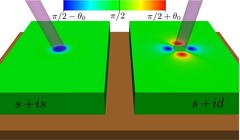 with Mihail Silaev and Egor Babaev
We show that superconductors with broken time-reversal symmetry have very specific
magnetic and electric responses to inhomogeneous heating. A local heating of such
superconductors induces a magnetic field with a profile that is sensitive to the
presence of domain walls and crystalline anisotropy of superconducting states.
A nonstationary heating process produces an electric field and a charge imbalance
in different bands. These effects can be measured and used to distinguish $s+is$
and $s+id$ superconducting states in the candidate materials such as
Ba$_{1-x}$K$_x$Fe$_2$As$_2$.
Published in
Phys. Rev. Lett. 116, 097002 (2016)
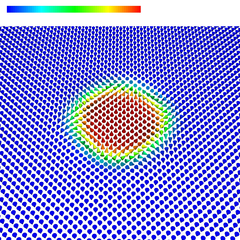 with Egor Babaev
Chiral $p$-wave superconducting state supports a rich spectrum of
topological excitations different from those in conventional
superconducting states. Besides domain walls separating different
chiral states, chiral $p$-wave state supports both singular and
coreless vortices also interpreted as skyrmions.
Here, we present a numerical study of the energetic properties of
isolated singular and coreless vortex states as functions of
anisotropy and magnetic field penetration length. In a given chiral
state, single quantum vortices with opposite winding have different
energies and thus only one kind is energetically favoured. We find
that with the appropriate sign of the phase winding, two-quanta
(coreless) vortices are always energetically preferred over two isolated
single quanta (singular) vortices. We also report solutions carrying
more flux quanta. However those are typically more energetically
expensive/metastable as compared to those carrying two flux quanta.
Published in
Scientific Reports 5, 17540 (2015)
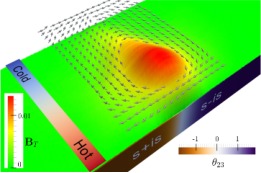 with Mihail Silaev and Egor Babaev
We demonstrate that superconductors which break time-reversal
symmetry can exhibit thermoelectric properties, which are entirely
different from the Ginzburg mechanism. As an example, we show
that in the $s+is$ superconducting state there is a reversible
contribution to thermally induced supercurrent, whose direction
is not invariant under time-reversal operation. Moreover in
contrast to Ginzburg's mechanism it has a singular behavior near
the time-reversal symmetry breaking phase transition. The effect
can be used to confirm or rule out the $s+is$ state, which is
widely expected to be realized in pnictide compounds
Ba$_{1-x}$K$_{x}$Fe$_2$As$_2$ and stoichiometric LiFeAs.
Published in
Phys. Rev. B 91, 104512 (2015)
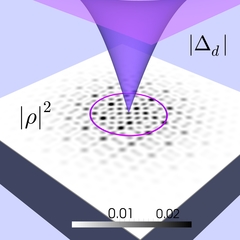 with Daniel F. Agterberg
We consider competing pair-density-wave (PDW) and d-wave superconducting
states in a magnetic field. We show that PDW order appears in the cores of
$d$-wave vortices, driving checkerboard charge-density-wave (CDW) order in
the vortex cores, which is consistent with experimental observations.
Furthermore, we find an additional CDW order that appears on a ring outside
the vortex cores. This CDW order varies with a period that is twice that of
the checkerboard CDW and it only appears where both PDW and $d$-wave order
coexist. The observation of this additional CDW order would provide strong
evidence for PDW order in the pseudogap phase of the cuprates. We further
argue that the CDW seen by nuclear magnetic resonance at high fields is due
to a PDW state that emerges when a magnetic field is applied.
Published in
Phys. Rev. B 91, 104512 (2015)
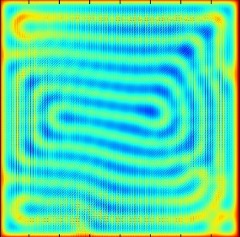
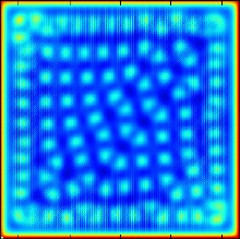 with Egor Babaev
We study superconductors with two order components and phase separation
driven by intercomponent density-density interaction, focusing on the phase
where only one condensate has nonzero ground-state density and a competing
order parameter exists only in vortex cores.
We demonstrate there that multibody intervortex interactions can be
strongly nonpairwise, leading to some unusual vortex patterns in an
external field, such as vortex pairs and vortex chains.
We demonstrate that in an external magnetic field such a system undergoes
a field-driven phase transition from (broken) $U(1)$ to (broken) $U(1)\times U(1)$
symmetries when a subdominant order parameter in the vortex cores acquires
global coherence. Observation of these characteristic ordering patterns
in surface probes may signal the presence of a subdominant condensate
in the vortex core.
Published in
Phys. Rev. B 91, 014510 (2014)
 with Egor Babaev
We study the properties of vortex solutions and magnetic response
of two-component $\mathrm{U}(1)\times \mathrm{U}(1)\times\mathbb{Z}_2$
superconductors, with phase separation driven by intercomponent
density-density interaction. Such a theory can be viewed arising
from the breakdown of $SU(2)$ symmetry by a biquadratic
interaction between the components of the field. Depending on the
symmetrry-breaking term, there are two ground-state phases: one where
both components of the doublet are equal (the miscible phase) and one
where only one component assumes a non zero vacuum expectation value
(the immiscible state). In the latter phase, the spectrum of topological
excitations contains both domain walls and vortices.
We show the existence of another kind of excitation that has properties
of both topological excitations at the same time. They combine
vorticity together with a circular domain wall, interpolating
between inequivalent broken states, that shows up as a ring of localized
magnetic flux.
Asymptotically, this resembles a vortex carrying multiple flux quanta,
but because the magnetic field is localized at a given distance from
the center this looks like a pipe. The isolated multiquanta pipelike
vortices can be either stable or metastable, even if the system is not
type-1. We also discuss the response of such a system to an externally
applied magnetic field.
Published in
Phys. Rev. B 90, 214524 (2014)
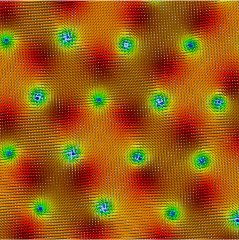 with Daniel Agterberg and Egor Babaev
When an in-plane field is applied to a clean interface superconductor,
a Fulde-Ferrell-Larkin-Ovchinnikov (FFLO)-like phase is stabilized.
This phase has a $ \mathrm{U}(1)\times\mathrm{U}(1) $ symmetry and, in
principle, this symmetry allows for flux carrying topological excitations
different from Abrikosov vortices (which are the simplest defects associated
with $ S^1\to S^1 $ maps). However, in practice, largely due to electromagnetic
and other intercomponent interactions, such topological excitations are very
rare in superconducting systems. Here we demonstrate that a realistic
microscopic theory for interface superconductors, such as SrTiO$_3$/LaAlO$_3$ ,
predicts an unconventional magnetic response where the flux-carrying objects
are skyrmions, characterized by homotopy invariants of $ S^2\to S^2 $ maps.
Additionally, we show that this microscopic theory predicts that stable fractional
vortices form near the boundary of these superconductors. It also predicts
the appearance of type-1.5 superconductivity for some range of parameters.
Central to these results is the assumption that the Rashba spin orbit coupling
is much larger than the superconducting gap.
Published in
Phys. Rev. B 90, 064509 (2014)
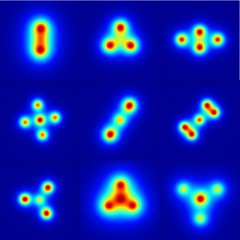 with Egor Babaev
We investigate the topological defects in phenomenological models describing
mixtures of charged condensates with commensurate electric charges. Such situations
are expected to appear for example in liquid metallic deuterium. This is modeled by
a multi-component Ginzburg-Landau theory where the condensates are coupled to the
same gauge field by different coupling constants whose ratio is a rational number.
We also briefly discuss the case where electric charges are incommensurate. Flux
quantization and finiteness of the energy per unit length dictates that the different
condensates have different winding and thus different number of (fractional) vortices.
Competing attractive and repulsive interactions lead to molecule-like bound state between
fractional vortices. Such bound states have finite energy and carry integer flux quantum.
These can be characterized by $\mathbb{C}P^1$ topological invariant that motivates their
denomination as skyrmions.
Published in
Phys. Rev. B 89, 214507 (2014)
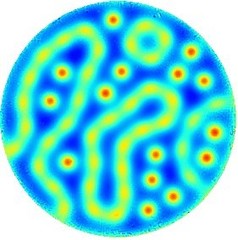 with Egor Babaev
Arguments were recently advanced that hole-doped Ba$_{1-x}$K$_x$Fe$_2$As$_2$
exhibits the $s+is$ state at certain doping. Spontaneous breaking of
time-reversal symmetry in the $s+is$ state dictates that it possess domain
wall excitations. Here, we discuss what are the experimentally detectable
signatures of domain walls in the $s+is$ state. We find that in this state
the domain walls can have a dipolelike magnetic signature (in contrast to
the uniform magnetic signature of domain walls $p+ip$ superconductors).
We propose experiments where quench-induced domain walls can be stabilized
by geometric barriers and observed via their magnetic signature or their
influence on the magnetization process, thereby providing an experimental
tool to confirm the $s+is$ state.
Published in
Phys. Rev. Lett. 112, 017003 (2014)
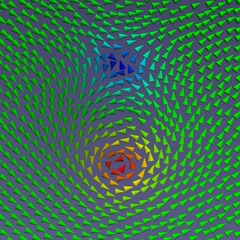 with Karl Sellin, Juha Jäykkä and Egor Babaev
Rather generically, multicomponent superconductors and superfluids have intercomponent
current-current interaction. This applies to wide range of physical systems from mixtures
of hadronic superfluids in neutron stars, ultracold atoms to $p$-wave superconductors.
Here we discuss how this kind of interaction affects magnetic response of superconductors.
Going beyond the frequently used London limit, we show that in superconductors with
substantially strong intercomponent drag interaction, the topological defects which form
in external field are Skyrmions. We study their properties and show that they can be
distinguished from ordinary vortices by a very characteristic magnetization process.
Published in
Phys. Rev. B 89, 104508 (2014)
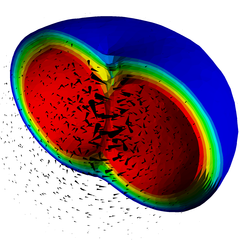 with Eugen Radu and Mikhail S. Volkov
We present for the first time solutions in the gauged $U(1)\times U(1)$ model of Witten
describing vortons -- spinning flux loops stabilized against contraction by the
centrifugal force. Vortons were heuristically described many years ago, however,
the corresponding field theory solutions were not obtained and so the stability
issue remained open. We construct explicitly a family of stationary vortons
characterized by their charge and angular momentum. Most of them are unstable and
break in pieces when perturbed. However, thick vortons with small radius preserve
their form in the $3+1$ non-linear dynamical evolution. This gives the first ever
evidence of stable vortons and impacts several branches of physics where they
could potentially exist. These range from cosmology, where vortons could perhaps
account for the cold dark matter, to condensed matter physics.
Published in
Phys. Rev. Lett. 111, 171602 (2013)
 with Johan Carlström, Egor Babaev and Martin Speight
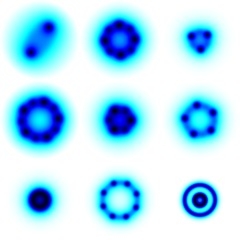
It is shown that under certain conditions, three-component superconductors
(and in particular three-band systems) allow stable topological defects different
from vortices. We demonstrate the existence of these excitations, characterized by a
$\ {\mathbb{C}}{{P}}^2\ $ topological invariant, in models for three-component
superconductors with broken time reversal symmetry. We term these topological defects
"chiral $GL^{(3)}$ skyrmions", where "chiral" refers to the fact that due to broken
time reversal symmetry, these defects come in inequivalent left- and right-handed versions.
In certain cases these objects are energetically cheaper than vortices and should be
induced by an applied magnetic field. In other situations these skyrmions are metastable
states, which can be produced by a quench. Observation of these defects can signal
broken time reversal symmetry in three-band superconductors or in Josephson-coupled
bilayers of $s_\pm$ and $s$-wave superconductors.
Published in
Phys. Rev. B 87, 014507 (2013)
 with Daniel Agterberg and Egor Babaev
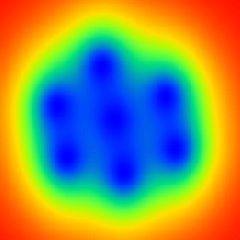
Recently vortex coalescence was reported in superconducting
Sr$_2$RuO$_4$ by several experimental groups for fields applied along
the $c$ axis. We argue that Sr$_2$RuO$_4$ is a type-1.5 superconductor
with long-range attractive, short-range repulsive intervortex interaction.
The type-1.5 behavior stems from an interplay of the two orbital degrees
of freedom describing this chiral superconductor together with the multiband
nature of the superconductivity. These multiple degrees of freedom give
rise to multiple coherence lengths, some larger and some smaller than
the magnetic field penetration length, resulting in nonmonotonic
intervortex forces.
Published in
Phys. Rev. B 86, 060513(R) (2012)
Article relegated in Russian popular science article Link
 with Egor Babaev
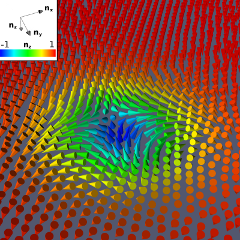
Observability of half-quantum vortices and skyrmions in $p$-wave
superconductors is an outstanding open question. Under the most common
conditions, fractional flux vortices are not thermodynamically stable
in bulk samples. Here we show that in chiral $p$-wave superconductors,
there is a regime where, in contrast, lattices of integer-flux vortices
are not thermodynamically stable. Instead, skyrmions made of spatially
separated half-quantum vortices are the topological defects produced by
an applied external field.
Published in
Phys. Rev. B 86, 060514(R) (2012)
 with Johan Carlström and Egor Babaev
A popular article on our research on type-1.5 superconductivity
(phys.org) -- “In this 100th anniversary year of the discovery
of superconductivity, physicists at the University of Massachusetts
Amherst and Sweden’s Royal Institute of Technology have published a
fully self-consistent theory of the new kind of superconducting
behavior, Type 1.5, this month in the journal Physical Review B.”
Read more on
phys.org
Article relegated in several popular science media : cryogenicsociety.org , rdmag.com , physicsforme , newswise.com , zeitnews.org , lescienze.it , engineersonline.nl , sverigesradio.se , mk.ru , sci.ipv2.info , donmarket.org , physics.com.ua , pavlonews.info , horoshienovosti.com.ua , scirt.ru , physiclib.ru , rsci.ru , nanonewsnet.ru , naukoved.ru , membrana.ru
 with E. Babaev , J. Carlström, M. Silaev and J. M. Speight
A conventional superconductor is described by a single complex order parameter field
which has two fundamental length scales, the magnetic field penetration depth $\lambda$
and the coherence length $\xi$. Their ratio $\kappa$ determines the response of a superconductor
to an external field, sorting them into two categories as follows; type-I when $\kappa < 1 / \sqrt{2}$
and type-II when $\kappa > 1/\sqrt{2}$. We overview here multicomponent systems which can possess three
or more fundamental length scales and allow a separate &ldquo type-1.5 &ldquo superconducting state when, e.g.
in two-component case $\xi_1<\sqrt{2}\lambda< \xi_2$.
In that state, as a consequence of the extra fundamental
length scale, vortices attract one another at long range but repel at shorter ranges. As a consequence the system
should form an additional Semi-Meissner state which properties we discuss below. In that state vortices form clusters
in low magnetic fields. Inside the cluster one of the component is depleted and the superconductor-to-normal interface
has negative energy. In contrast the current in second component is mostly concentrated on the cluster's boundary,
making the energy of this interface positive. Here we briefly overview recent developments in Ginzburg-Landau and
microscopic descriptions of this state.
Published in
Physica C 479, 2-14 (2012)
 with Johan Carlström and Egor Babaev
We show that three-band superconductors with broken time reversal symmetry allow magnetic
flux-carrying stable topological solitons which have only a slightly higher energy than ordinary vortices.
Therefore they can be induced by fluctuations or quenching the system through a phase transition. It can
provide an experimental signature of the time reversal symmetry breakdown.
Published in
Phys. Rev. Lett. 107, 197001 (2011)
 with Johan Carlström and Egor Babaev
The recent discovery of iron pnictide superconductors has resulted in a rapidly growing
interest in multiband models with more than two bands. In this work we specifically focus on the
properties of three-band Ginzburg-Landau models which do not have direct counterparts in more studied
two-band models. First we derive normal modes and characteristic length scales in the conventional $U(1)$
three-band Ginzburg-Landau model as well as in its time reversal symmetry broken counterpart with
$U(1)\times Z_2$ symmetry. We show that in the latter case, the normal modes are mixed phase/density
collective excitations. A possibility of the appearance of a massless phase-difference mode associated
with fluctuations of the phase difference is also discussed. Next we show that gradients of densities
and phase differences can be inextricably intertwined in vortex excitations in three-band models. This
can lead to very long-range attractive intervortex interactions and appearance of type-1.5 regimes even
when the intercomponent Josephson coupling is large. In some cases it also results in the formation of
a domain-like structures in the form of a ring of suppressed density around a vortex across which one
of the phases shifts by $\pi$. We also show that field-induced vortices can lead to a change of broken
symmetry from $U(1)$ to $U(1)\times Z_2$ in the system. In the type-1.5 regime, it results in a semi-Meissner
state where the system has a macroscopic phase separation in domains with broken $U(1)$ and $U(1)\times Z_2$ symmetries.
Published in
Phys. Rev. B 84, 134518 (2011)
 with Johan Carlström and Egor Babaev
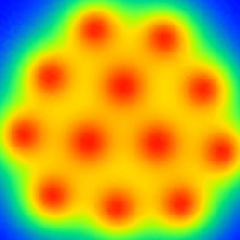
We demonstrate existence of non-pairwise interaction forces between vortices in
multicomponent and layered superconducting systems. That is, in contrast to most
common models, the interactions in a group of such vortices is not a universal
superposition of Coulomb or Yukawa forces. Next we consider the properties of vortex
clusters in Semi-Meissner state of type-1.5 two-component superconductors. We show that
under certain condition non-pairwise forces can contribute to formation of very complex
vortex states in type-1.5 regimes.
Published in
Phys. Rev. B 84, 134515 (2011)