- Daniel Agterberg, University of Wisconsin-Milwaukee, Milwaukee, WI, USA
- Egor Babaev, Royal Institute of Technology (KTH), Stockholm, Sweden
- Troels Arnfred Bojesen, RIKEN Center for Emergent Matter Science, Wako, Saitama, Japan
- Johan Carlström, Stockholm University, Stockholm, Sweden
- Maxim Chernodub, Institut Denis Poisson, University of Tours, France
- Alberto Corticelli, Max Planck Institute, Dresden, Germany
- Vadim Grinenko, Tsung-Dao Lee Institute, Shanghai, CN
- Juha Jäykkä, University of Cambridge, Cambridge, UK
- Dmitri Kharzeev, Stony Brook University, Stony Brook, NY
- Antti Niemi, NORDITA, Stockholm University and Uppsala University, Stockholm, Sweden
- Eugen Radu, Departamento de Fisica, Universidade de Aveiro, Portugal
- Filipp Rybakov, Department of Physics and Astronomy, University of Uppsala, Sweden
- Albert Samolienka, Royal Institute of Technology (KTH), Stockholm, Sweden
- Karl Sellin, Royal Institute of Technology (KTH), Stockholm, Sweden
- Mihail Silaev, Royal Institute of Technology (KTH), Stockholm, Sweden
- Martin Speight, School of Mathematics, University of Leeds, UK
- Asle Sudbø , Norwegian University of Science and Technology (NTNU), Trondheim, Norway
- Mikhail Volkov, Institut Denis Poisson, University of Tours, France
- Alexander Zyuzin, Royal Institute of Technology (KTH), Stockholm, Sweden
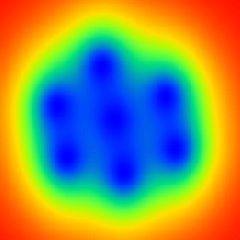 under construction
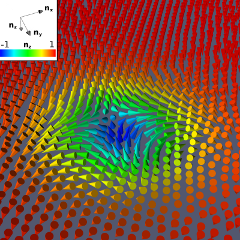 under construction
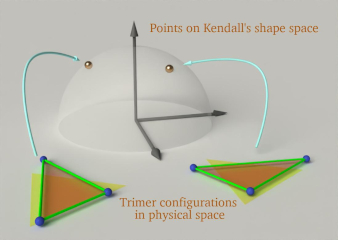 with A. J. Niemi
Animations showing close orbites ob Kendall shapes sphere, and qubit realization as a relative stationary superposition of the Higgs ocsillator eigenstates.
Link
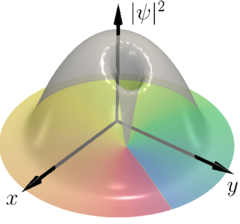 with J. Dai and A. J. Niemi
Animations showing minimal energy states and their time-evolution in a cold
atomic Bose-Einstein condensate.
Link
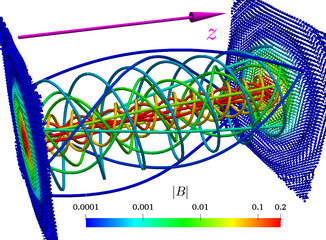 with M. N. Chernodub and D. E. Kharzeev
Animations showing helicoidal patterns around a straight static vortex,
in noncentrosymmetric superconductors.
Link
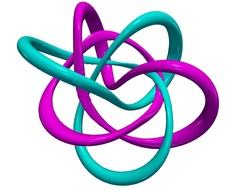 with Filipp N. Rybakov and Egor Babaev
Animations showing the core structure of stable knotted loops of fractional
vortices, in two-component superconductors with Andrrev-Bashkin dissipationless
drag.
Link
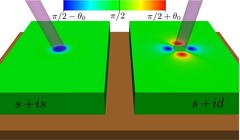 with Mihail Silaev and Egor Babaev
Animations showing the evolution of the magnetic and electric responses
that originates in time-varying local heating of the sample, which can
for example be induced by a laser. This display responses for both the
cases of $s+is$ and $s+id$ pairing symmetry, with and without domain-walls.
Link
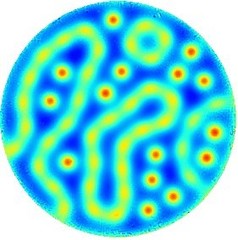 with Egor Babaev
Animations showing the magnetization process and field
cooled experiments in $ s+is $ superconductors.
Link
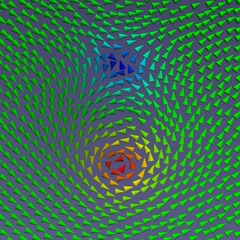 with Karl Sellin, Juha Jäykkä and Egor Babaev
Animations showing the magnetization process of a two-component
$ \mathrm{U}(1)\times\mathrm{U}(1) $ superconductor with a
dissipationless drag.
This shows the Skyrmions magnetization process of a finite
sample in a slowly increasing applied magnetic field.
Link
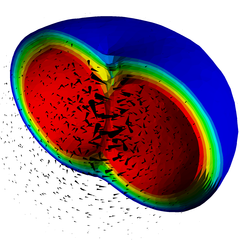 with Eugen Radu and Mikhail Volkov
Animations showing the dynamical evolution of vortons.
Both unstable and stable regimes are found.
Link
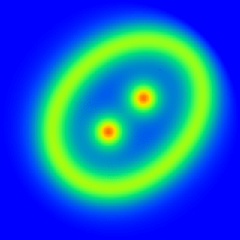 with Johan Carlström and Egor Babaev
Animations showing formation mechanisms of chiral skyrmions in three
component superconductors with broken time reversal symmetry. The chiral
skyrmions are tological solitons made out of vortices confined on a closed
domain-wall separating regions of opposite phase-locking pattern.
Link
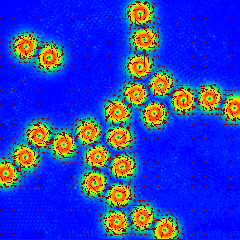 with Johan Carlström and Egor Babaev
Video animations of vortex clusters, occuring in two-component
Ginzburg--Landau theory. Non-monotonic intervortex interactions lead
to formation of vortex clusters surrounded by macroscopic Meissner domains.
Structure formation can be very complicated, because of non-pairwise
interactions originating in the non-linear superposition of vortices.
Link